
The term industrial statistics refers to statistical methods used in the industrial manufacturing of products and/or for the definition and optimization of processes. Some of these methods follow a standardization others are defined industry-specific.


🧪 DoEStat – Statistical Design of Experiments (DoE) for professional use DoEStat is the complete DoE suite for development, formulation and process optimisation: every relevant design type, modern analysis and multi-response optimisation in one Windows application – no add-on modules, no forced cloud. Developed in Germany by statisticians for use in regulated industries. ✅ Why DoEStat? 🧩 One program, start to finish – planning, data entry, analysis, optimisation and report in a single application, with no separately licensed extensions 📚 Scientifically grounded – every method follows a published standard reference (Montgomery, Myers, Cornell, Box & Hunter, Scheffé, Jones & Nachtsheim …); numerical kernels are checked against R and NIST reference data 🔒 Your data stays local – native .NET 9 Windows application, projects are files on your machine or network share, no user account, no cloud 🔄 Switch without losing data – existing Design-Expert projects (.dxpx) import directly, with a preview and a list of notes before anything is taken over 🌐 Bilingual – German and English interface with contextual help and result interpretation 🏭 GxP-ready – validation support with a categorised changelog (Impact on Validation / Numerical Impact / Non-Validation-Relevant) 📐 Designs – 19 design types, no add-on module 🔹 Screening: full factorial (2k and mixed-level), fractional factorial 2k−p with alias structure and resolution III–V, Plackett-Burman, definitive screening (DSD), min-run resolution IV and V 🔹 Response surfaces: central composite (CCD, rotatable / face-centred / inscribed), Box-Behnken 🔹 Optimal designs: D-, A-, I- and G-optimal by coordinate exchange – able to hold already-executed runs fixed 🔹 Mixtures: simplex-lattice, simplex-centroid, extreme vertices (constrained), optimal mixture designs, mixture × process, mixture-amount 🔹 Robust & special: Taguchi arrays (L4 … L36), robust parameter design (inner/outer), nested (hierarchical), Latin hypercube 🔹 Split-plot / split-split-plot: hard-to-change factors automatically get their own randomisation stratum 🔹 Augment instead of starting over: fold-over, axial points, lack-of-fit points or a criterion-driven top-up of an existing design 📊 Analysis – what becomes of the measurements 🔹 Model & fit: regression with ANOVA (R², adjusted R², predicted R²), lack-of-fit test, model selection by AIC/BIC with term hierarchy, Box-Cox transformation, generalised regression (ridge) 🔹 Separating effects: half-normal plot, Pareto chart with t and Bonferroni limits, Lenth PSE, two-stage DSD analysis 🔹 Diagnostics & prediction: studentised residuals, normal Q-Q, leverage, Cook's D, DFFITS, VIF, confidence and prediction intervals, confirmation runs 🔹 Structure & distribution: split-plot and split-split-plot (REML), nested ANOVA, mixed models, binomial & Poisson GLM, mixture ANOVA (Scheffé) 🔹 Optimisation & robustness: desirability (Derringer-Suich), Pareto front, profiler & ramps, overlay / sweet spot, propagation of error (POE), Monte Carlo with defect rate and Cpk, robust parameter design (S/N) 🔹 Evaluating the design: power per effect, replicates from power, D/A/G efficiency, FDS curves, prediction variance, strategy comparison 📈 18 charts – from design to optimum FDS curves, prediction variance, correlation matrix, power curves, half-normal, Pareto, interaction, residuals, normal Q-Q, Box-Cox, contour, 3-D surface, profiler, overlay (sweet spot), ramps, mixture trace, ternary contour, Monte Carlo – all interactive, all produced by DoEStat itself. 🌍 Typical applications ✔️ Pharma & biotechnology (formulation, process validation, QbD) ✔️ Chemistry & process engineering ✔️ Materials science & materials development ✔️ Food & cosmetics formulations (mixture designs) ✔️ Manufacturing & process optimisation (robust design, Six Sigma) ✔️ Universities & research institutions 🔑 Licence models 🔹 Commercial – named-user annual licence, full feature set, e-mail support (EN/DE); volume pricing from 5 licences 🔹 Academic – identical feature set for teaching and non-commercial research (proof of institution required) 🔹 Free trial – 30 days, full feature set, no payment details needed 🔹 After expiry the installation stays usable as a free viewer: open projects, inspect results, export reports (watermarked) – colleagues, reviewers and auditors need no licence of their own All licences and the trial are available through STATCON – use the request form or write to vertrieb@statcon.de. We are happy to advise on the right licence model and prepare a quote. 💬 In short: DoEStat – Design of Experiments without compromise DoEStat brings the complete DoE workflow – from planning to multi-response optimisation – into a modern, local Windows application with a clear licence model. If you work with Design-Expert you will feel at home right away and can bring your projects with you. STATCON supports you as authorised partner in Germany, Austria and Switzerland with sales, training and DoE consulting. 📥 Try it for free or request a quote: ➡ Visit the DoEStat product page ➡ Quote, trial, academic and volume licences: vertrieb@statcon.de or via the request form

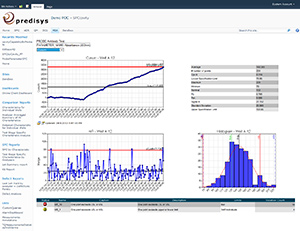
🏭 Predisys Analytical Suite® – Intelligent SPC Software for Industry 4.0 Predisys Analytical Suite is a scalable, browser-based solution for Statistical Process Control (SPC) and quality-related data analysis—purpose-built for the demands of Industry 4.0. The software enhances product quality, reduces operational costs, and delivers transparency and control across manufacturing processes. ✅ Why Choose Predisys? 🔧 Comprehensive SPC functionality – Control charts, process monitoring & root cause analysis 📈 Improved quality & cost-efficiency – Identify trends and deviations early 🌐 Fully browser-based – No local installation, ideal for IT teams & global collaboration 🧠 Industry 4.0 ready – Easily integrates with Lean, Six Sigma, TQM & digital manufacturing strategies 📊 For beginners & experts alike – Intuitive dashboards for plant managers, detailed analytics for quality engineers 💼 Built on Microsoft SharePoint – Scalable, secure, and enterprise-ready platform integration 🧩 Key Features of the Predisys Analytical Suite 🔹 Statistical Process Control (SPC): • Multiple control chart types (X̄-R, p, np, u, c, etc.) • Automated trend detection and deviation analysis • Visual alerts & customizable control limits 🔹 Quality Data Analytics: • Advanced statistical tools and analytics • Monitor quality metrics over time and across product lines • Integration with MES/ERP systems for automated data flow 🔹 Digitalization & Industry 4.0: • Real-time, connected quality data across systems • Support for IoT/sensor-driven production environments • Ideal for Predictive Quality and Continuous Improvement initiatives 🔹 User-Friendly Interface: • Role-based dashboards tailored for different user levels • One-click export of reports & visualizations • Granular permission settings and secure data access 🌍 Typical Use Cases ✔️ Automotive & suppliers ✔️ Mechanical & plant engineering ✔️ Electronics & microelectronics manufacturing ✔️ Plastics & metal processing ✔️ Aerospace & defense industries ✔️ Medical technology & high-tech production 💬 Conclusion: Predisys – SPC and Quality Intelligence for Connected Manufacturing With Predisys Analytical Suite, organizations leverage a future-ready platform for quality monitoring, continuous improvement, and production intelligence. It combines the strengths of traditional SPC with modern Industry 4.0 integration—intuitive, powerful, and fully browser-based. 📥 Learn more or request a demo now: ➡ Visit the Predisys Product Page Möchtest du auch eine Kurzversion für LinkedIn, ein Executive Summary für Entscheider oder eine Gegenüberstellung mit klassischen On-Premise-SPC-Systemen? Gib mir einfach Bescheid!

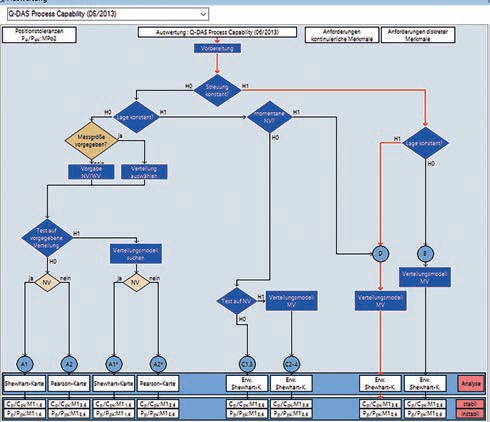
📊 Q-DAS qs-STAT® – Reliable Industrial Statistics for Quality Evaluation Q-DAS qs-STAT® is the industry-established software solution for standardized and insightful statistical evaluations in manufacturing. It provides reliable quality metrics, supporting process-secure decision-making, continuous improvement, and globally comparable results. ✅ Why Choose qs-STAT? 📈 Validated statistical methods according to international standards 📏 Integrated norms & guidelines – e.g., DIN ISO 22514-2 and OEM-specific standards (BMW, Bosch, VW, GMPT, etc.) 🌍 Multilingual interface – optimized for global users 🧠 Automatic distribution analysis & process model assignment 🖥️ Intuitive visualizations – quickly identify critical process deviations 🔄 SAP integration (QM-STI) – use quality metrics & reports directly within your SAP system 🔒 Conformity declaration for compliant use in certified QM environments 🛠️ Key Features at a Glance 🔹 Statistical evaluation of manufacturing-relevant quality data 🔹 Automatic selection of the best-fitting distribution model 🔹 Assignment to appropriate process models (per ISO 22514-2) 🔹 Powerful filter and selection tools for targeted analysis 🔹 Customizable reports & dashboards for various user roles 🔹 Multilingual user interface – ideal for global manufacturing networks 🔹 Supports process and machine capability studies 📊 Clear Visual Insights – Instant Process Understanding ✔️ High-impact charts and graphs – including boxplots, trend charts, capability analyses ✔️ Highlighting of critical deviations – built-in visual alert systems ✔️ Clean, intuitive layouts – focus on exceptions and optimization opportunities ✔️ Direct derivation of corrective actions – fast, data-driven decisions 🔗 Seamless SAP Integration (QM-STI) 📎 If your inspection and measurement data is stored in SAP QM, qs-STAT can automatically analyze it. All metrics, charts, and reports are directly accessible in your SAP system – combining the strengths of both platforms for effective quality assurance. 🔒 Certified Suitability for Norm-Compliant Use ✔️ Meets key quality standards like ISO 9001, IATF 16949, and others ✔️ Verified suitability for initial and continuous deployment 📄 View Declaration of Suitability (PDF) 💬 Conclusion: qs-STAT – The Industrial Standard for Statistical Process Evaluation Q-DAS qs-STAT is the go-to solution for companies requiring transparent, standardized, and globally understandable quality analysis – from shop floor to top floor, from local plants to global enterprises. 📥 Learn more or request a free demo now: ➡ Visit the Q-DAS product page: www.q-das.com

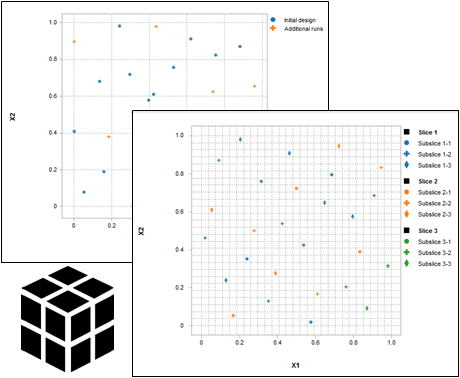
🤖 SmartUQ – Powerful Machine Learning Software for Science & Engineering SmartUQ is an advanced machine learning (ML) software solution purpose-built for scientific and engineering applications. Featuring high-precision ML models, an intuitive graphical interface, and powerful APIs, SmartUQ enables seamless development of predictive models, optimized sampling, uncertainty quantification, and model calibration. ✅ Why SmartUQ? For manufacturers and engineering consultants, SmartUQ delivers industry-leading predictive modeling accuracy that helps streamline and optimize design and development processes. Over recent years, SmartUQ has significantly expanded its scope to support a full range of AI and machine learning applications—empowering teams across the entire product lifecycle. From early design exploration to simulation-based analysis, optimization, and quality assurance—SmartUQ is your intelligent companion for data-driven engineering. 🧠 Key Capabilities of SmartUQ ✔️ Design of Experiments (DOE) for Simulations Efficient sampling strategies to collect the most informative data for model training. ✔️ Modeling & Emulation Build high-precision surrogate models for simulation-based and experimental systems. ✔️ Sensitivity Analysis Quantify the influence of input variables on system performance. ✔️ Model Calibration & Tuning Refine your models by adjusting inputs to improve predictive accuracy. ✔️ Statistical Optimization & Adaptive Sampling Boost design and operational efficiency through intelligent data acquisition. ✔️ Uncertainty Propagation & Risk Analysis Incorporate uncertainty quantification to assess risks and build robust systems. 🎯 Conclusion: Smarter Engineering with SmartUQ With SmartUQ, organizations gain access to a powerful, accurate, and flexible ML platform tailored for engineering simulation, design optimization, and AI-powered product development. 🚀 Take control of your modeling process and turn data into insight. 📥 Learn more and revolutionize your modeling & analytics with SmartUQ: ➡ Visit the official SmartUQ website
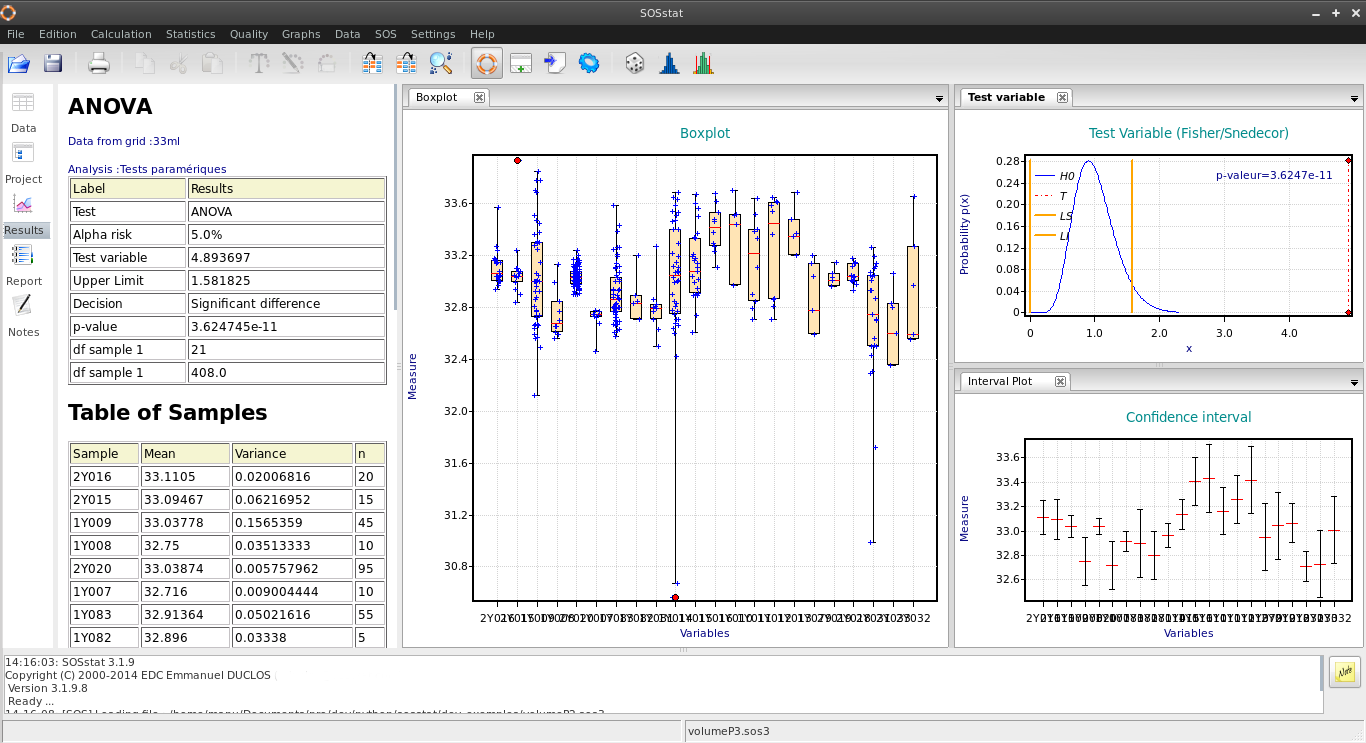
🏭 SOSstat Quality® – Statistical Software for Industrial Quality Improvement SOSstat Quality is a powerful software solution for statistical process control (SPC) and quality improvement in industrial environments. Specifically designed for engineers, technicians, and production teams, it combines ease of use with robust statistical tools, enabling quick and accurate analysis with minimal training. ✅ Why Choose SOSstat Quality? 🔍 Comprehensive statistical tools – For process analysis, monitoring, and optimization 📊 Modern visualizations & intuitive graphics – For fast, clear insights 🛠️ Built for industrial use – Ideal for manufacturing, quality management & validation 🚀 Integrated Six Sigma project management – Supports continuous improvement initiatives 🧠 Assistant-guided workflows – Designed for users with or without statistical expertise 🌐 Application Areas ✔️ Microelectronics & semiconductor industry ✔️ Aerospace & aviation ✔️ Mechanical & automotive engineering ✔️ Plastics & textile manufacturing ✔️ Medical devices & precision instruments ✔️ Quality management & regulatory validation 🧪 SOSstat VPAQ® – Simplifying Analytical Method Validation SOSstat VPAQ is a specialized tool for the validation of quantitative analytical methods – ideal for industries where regulatory compliance and scientific precision are critical. 🎯 Designed for: ✔️ Chemical analysis ✔️ Pharmaceutical quality assurance ✔️ Food testing and laboratory analytics With SOSstat VPAQ®, you can perform validations based on internationally recognized standards – accurately, efficiently, and in full compliance. 📐 Validation According to International Guidelines 📏 Total Error approach – Scientifically robust and easy to interpret 📘 Compliant with SFSTP & NF V 03-110 🌍 Aligned with ICH guidelines & ISO 5725 🔬 Scientifically validated & industry-proven – Trusted across sectors worldwide 🎯 Key Benefits at a Glance 🔒 Regulatory-compliant validation methodology 📈 Improved accuracy & reproducibility 📎 Demonstrable quality of products & processes 📂 Reliable documentation & integrated project tracking 💬 Conclusion: SOSstat – Quality at the Highest Level Whether you're conducting a production analysis, leading a Six Sigma project, or performing method validation – SOSstat Quality® and SOSstat VPAQ® provide the essential tools to work efficiently, transparently, and in full compliance with industry standards. 📥 Learn more & request your free demo today! ➡ Contact us for product information or personal consultation.

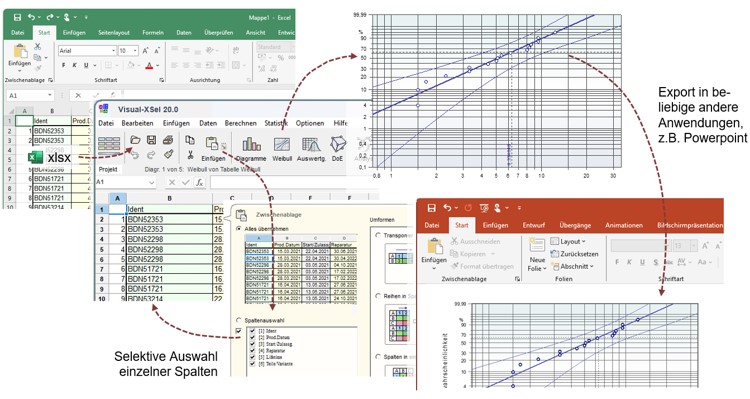
Visual-XSel: Easy Application of Powerful Methods for Reliability Analysis, Weibull Analysis, and Design of Experiments Visual-XSel is a user-friendly software that offers a variety of powerful methods for reliability analysis, Weibull analysis, and design of experiments (DOE). With Visual-XSel, users can easily apply complex statistical methods without requiring deep prior knowledge. Our goal is to make complex analytical processes accessible while ensuring the correct interpretation of results. Reliability Analysis with Visual-XSel Visual-XSel offers comprehensive features for reliability analysis, allowing users to evaluate the lifetime and failure probability of products or systems. With powerful algorithms, users can accurately determine reliability metrics and easily visualize the results in clear, informative charts. Weibull Analysis Made Easy Weibull analysis is one of the most important methods for analyzing the lifespan of products. Visual-XSel provides an intuitive user interface that allows users to quickly determine Weibull parameters and accurately visualize the results. The software guides users through the entire analysis process and provides valuable expert tips for interpreting the results correctly. Efficient Design of Experiments and Analysis Visual-XSel also simplifies design of experiments (DOE) by providing an easy-to-use interface that enables users to create, simulate, and analyze experiment designs. This allows you to find the optimal experimental setup for your tests and analyze the results effectively. Step-by-Step Guidance and Expert Knowledge The software leads users through the analysis procedures step-by-step and ensures that even complex data is interpreted correctly. With the help of tooltips and interactive instructions, users receive expert advice for interpreting the results at every stage of the process. Why Visual-XSel? Ease of Use: Visual-XSel makes reliability analysis and Weibull analysis easy and accessible. Step-by-Step Guidance: Users are guided through the entire analysis process. Expert Knowledge: Built-in tips help ensure correct interpretation of results. Powerful Methods: Leverage proven analysis techniques that are easy to apply. Conclusion With Visual-XSel, users can easily perform powerful analytical methods such as Weibull analysis, reliability analysis, and design of experiments without having to rely on complex software solutions.